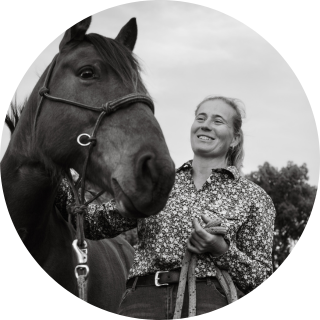
The horse looks up. Something caught his attention: a sound, a movement, something we didn’t see. We stop what we’re doing. We go to him. We put a hand on his neck and speak in a low, calm voice, and we stand there with him until he settles.
It looks like good horsemanship. And somewhere underneath all of it, our own heart rate has lifted, our jaw has tightened, and some part of us is already running the calculation: how bad could this get, and how do I make it stop.
We’ve all done this. The question worth sitting with is: who needed to stop?
Co-regulation is not a wellness concept
Co-regulation is a biological process, not a wellness concept. When one nervous system is operating from a state of relative safety, it can offer itself as a resource to a nervous system in distress. The mechanism runs through multiple channels at once: breathing patterns synchronise, heart rate variability shifts, subtle postural and vocal cues send signals that the body reads before the conscious mind has caught up. This is the science, grounded in polyvagal theory and refined through decades of clinical application in trauma and attachment work.
The part that matters most for horse owners, and the part that gets quietly dropped in the popular version of this idea, is the prerequisite. One nervous system has to be regulated for the process to function. This is not a clinical opinion or a therapeutic recommendation. It is built into the definition of co-regulation itself. Two dysregulated systems do not find each other and settle. They read each other’s activation as confirmation of threat, and they escalate together.
The horse is already doing its part of this. Through a process called neuroception, the horse’s nervous system is constantly scanning the environment for cues of safety or danger, and it is reading the rider’s physiological state as part of that scan. Breathing, muscle tone, micro-facial cues, the quality of tension in the hand that holds the lead rope. All of it is being processed, continuously, in real time, below the level of either party’s conscious awareness. The horse is not waiting for a training aid. It is already reading the transmission.
The only question is whether we are managing that transmission deliberately, or leaving it to chance.
When the soothing isn’t landing
Back to the horse looking up, and the rider going to soothe him.
Here is what can actually be happening in that moment. The rider sees the horse tense and becomes anxious about what might come next. She needs to stop, to feel like she has done something, to be closer to the situation rather than waiting for it to develop. She goes to the horse. She tells herself she is regulating him. But her own nervous system is still broadcasting activation: the lifted heart rate, the tight jaw, the braced breath. And the horse is reading that transmission clearly, regardless of what her hands are doing or what her voice is saying.
The soothing is not landing as regulation because the regulated system that co-regulation requires is not yet present. What the horse receives is not calm. It is attention directed at him from a nervous system that is itself uncertain. And uncertainty, in a horse’s threat-detection system, is not neutral. It is data. Often it is confirming data.
The horse may settle eventually. Horses are remarkably good at finding their own way back to baseline. But the settling happened despite the interaction, not because of it. When the horse licks and chews in that moment, it confirms the nervous system has downshifted, not that anything in the training relationship was resolved. And the next time something catches his attention, the pattern will run again.
A question about equine-assisted therapy
There is a question I have carried for a while about equine-assisted therapy settings, and I want to raise it carefully rather than as a verdict, because this is a field that does real and meaningful work for many people.
The claimed benefit in some of these settings is the horse’s regulating effect on the human. The horse is calm, the human co-regulates with the horse, and something therapeutic happens in that exchange. I believe that can be true. I also think it requires the horse to actually be in the state the mechanism needs: ventral vagal, socially engaged, regulated. Relaxed muscle tone, fluid movement, rhythmic breath, a nervous system genuinely at rest.
The thing is, freeze and shutdown in horses can look, from the outside, very much like calm. A horse in dorsal vagal collapse is quiet, compliant, unresponsive. It looks like the ideal therapy horse. But a shut-down nervous system cannot offer the social engagement cues that are the actual mechanism of co-regulation. If the horse is shut down rather than settled, the therapeutic claim rests on a misread.
I am not saying this is what is happening in all equine therapy settings, or even in most of them. I am saying it is a question worth asking, and that the people best placed to ask it are the ones in those settings who know horses well enough to tell the difference.
This is not the same as desensitisation
Desensitization works by repeated exposure until the horse stops responding. It targets the horse’s nervous system and changes it through habituation. It is something done to a horse.
What we are talking about here works differently. A regulated nervous system offered as a reference point, available to borrow from. The horse’s system entrained to the rider’s. Not something imposed. Something brought.
If the horse is continuously reading and responding to the rider’s physiological state, then that state is not background noise to the training work happening in the foreground. It may be the more powerful variable, and it is operating in every single interaction, not only the ones where a training protocol is being consciously applied. Desensitization has its place. This is not an argument against it. But if the rider is broadcasting activation while running a desensitization protocol, the protocol is working against itself, and the rider may not know it.
Self-regulation deserves to be in the toolbox earlier, and higher, than it usually is.
Your nervous system is a training variable
We already understand that the rider’s physical state is not separate from the horse’s training. Research into how rider asymmetry and biomechanical tension affects the horse’s movement has made physical balance a prerequisite, not a nice extra. We train position, we correct asymmetry, we develop independent seats, because we know that what the rider’s body does travels directly into the horse’s body.
The same logic applies to the rider’s nervous system. If the horse is reading it continuously, it is a training variable. It should be treated like one.
Practically, this looks like knowing when you are dysregulated before the behaviour escalates: yours and the horse’s, and in that order. It looks like some days not being the day to push through, not because you are giving up, but because on that day you would be asking the horse to be the regulated partner in an exchange where you cannot yet hold that side. Choosing to work on yourself on those days, to do something that brings your own system back to a place of genuine ease before asking anything of the horse, is not weakness. It is accurate reading of the most important variable in the session.
Showing up calm, safe, and present is a skill. It requires the same honest self-assessment as any other technical competency. And it is working on your horse whether you are attending to it or not.
The horse looked up at something. We stopped. We went to him.
Next time, before the hand goes to his neck, it might be worth pausing for one breath and asking: is my system settled enough to offer something worth borrowing?
Because he is already asking that question. He has been asking it since we walked through the gate.
This is the work we do directly in coaching, looking at both you and your horse together, and what your nervous system is actually transmitting. If you are on the Mid North Coast, I offer in-person sessions within 1.5 hours of South West Rocks. If you are further away, online coaching is available for riders anywhere in the world.
Discover more from EquiKinder by Lisa Rothe
Subscribe to get the latest posts sent to your email.
