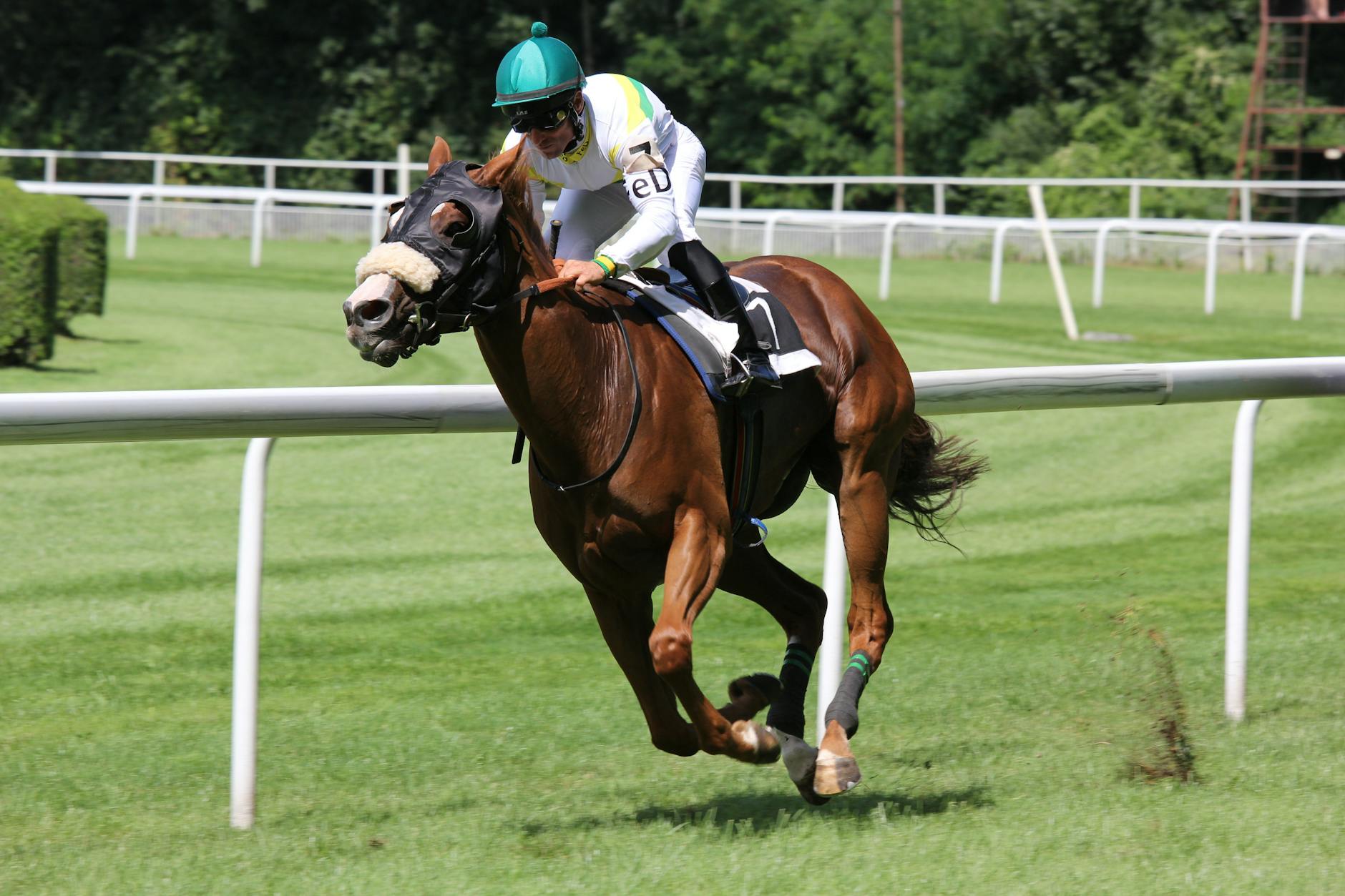
If you’ve ever worked with an off-the-track Thoroughbred (OTTB), you’ve probably noticed it: they’re supple and willing one way, but resistant, heavy, or even downright clumsy the other. Many riders chalk this up to personality quirks or training issues, but there’s a clear reason behind it.
Let’s unpack why OTTBs carry these asymmetries, what it looks like in retraining, and the five go-to exercises that can help bring them into balance.
Why Do OTTBs Come Off the Track Crooked?
In Australia, racetrack direction changes depending on the state:
- Victoria, South Australia, Tasmania, Western Australia → race anti-clockwise (left-handed).
- Queensland, New South Wales → race clockwise (right-handed).
Most horses train and gallop daily at their home track, which means their muscles, joints, and neural patterns are conditioned to one direction. Unless a horse reached elite level and travelled interstate for carnivals, their crookedness almost always reflects the track direction of their state.
Pro tip: Look up your horse’s racing record. The states where they trained and raced will give you immediate insight into their likely dominant side and weaker side.
Retraining isn’t about “fixing” a broken horse: it’s about gently unwinding years of one-sided training while helping them rediscover balance and straightness.
Don’t Rely Only on Track Direction Alone
While track direction explains a lot about OTTB crookedness, it’s not the whole story. Some ex-racehorses will show the opposite of what you expect based on their state’s racing direction. Why?
- Overuse and avoidance: The lead most used in racing can become sore or avoided rather than strong.
- Old injuries: A strain on one hind or shoulder may cause long-term compensation that flips the pattern.
- Training habits: In general, OTTBs don’t receive much formal schooling in rider aids. On the track, the focus is on speed, not refinement. So what feels like resistance or weakness under saddle may actually be confusion or a gap in training rather than a true physical imbalance.
- Natural asymmetry: Every horse has one side stronger than the other, and this may overlay or contradict their racing history.
- Learned resistance: A horse may resist a certain bend, rein, or canter lead not from weakness but from past bad experiences or associations with discomfort.
The takeaway: Observe your horse as an individual. Use the track direction and race record as a guide, but let today’s body tell you where the real weakness and strength are.
How to Assess Your Horse’s Weak Side
When a horse is trained to go in one direction around the track, its body develops unevenly. The inside hind leg does most of the pushing, while the outside shoulder carries more weight to balance the turns. Over time, this creates a dominant diagonal pair (inside hind + outside shoulder). That diagonal becomes stronger, while the opposite diagonal stays weaker. While the crookedness comes from diagonal pairs, for practical training, it makes most sense to think in terms of left vs. right side weakness. The hindquarters set the pattern, and the shoulders reflect it.
With that in mind, here are some simple ways to check for your OTTB’s weak side:
Bending / Lateral Flexion
| Observation | Explanation | Conclusion |
|---|---|---|
| More flexible to the left / Resistance bending to the right | When the horse bends left, the right side of the body (neck and ribcage) is stretching and lengthening, while the left side is tighter and shorter. This usually means the left side is the stronger, more developed side. | Weak Right |
| More flexible to the right / Resistance bending to the left | When the horse bends right, the left side of the body (neck and ribcage) is stretching and lengthening, while the right side is tighter and shorter. This usually means the right side is the stronger, more developed side. | Weak Left |
Circling
| Observation | Explanation | Conclusion |
|---|---|---|
| Falling Out (Drifting Outward) | The outside shoulder carrying too much weight (outside lateral pair overloaded) often due to the inside hind leg not stepping under to carry weight. | Circling Left: Weak Left Circling Right: Weak Right |
| Falling In (Leaning Inward) | The horse’s inside shoulder and inside foreleg are taking too much weight (inside lateral pair overloaded) due to insufficient support from the outside hind and outside half of the body. | Circling Left: Weak Right Circling Right: Weak Left |
Canter Leads
| Observation | Explanation | Conclusion |
|---|---|---|
| Struggles to depart on/ maintain the right lead | Asking for the right lead requires the right hind to push and carry. If the horse struggles, the right hind is weaker and less coordinated. | Weak Left |
| Struggles to depart on/ maintain the left lead | Asking for the right lead requires the left hind to push and carry. If the horse struggles, the left hind is weaker and less coordinated. | Weak Right |
This easy-to-use guide will help you identify your horse’s weaker side and better understand imbalances in training.
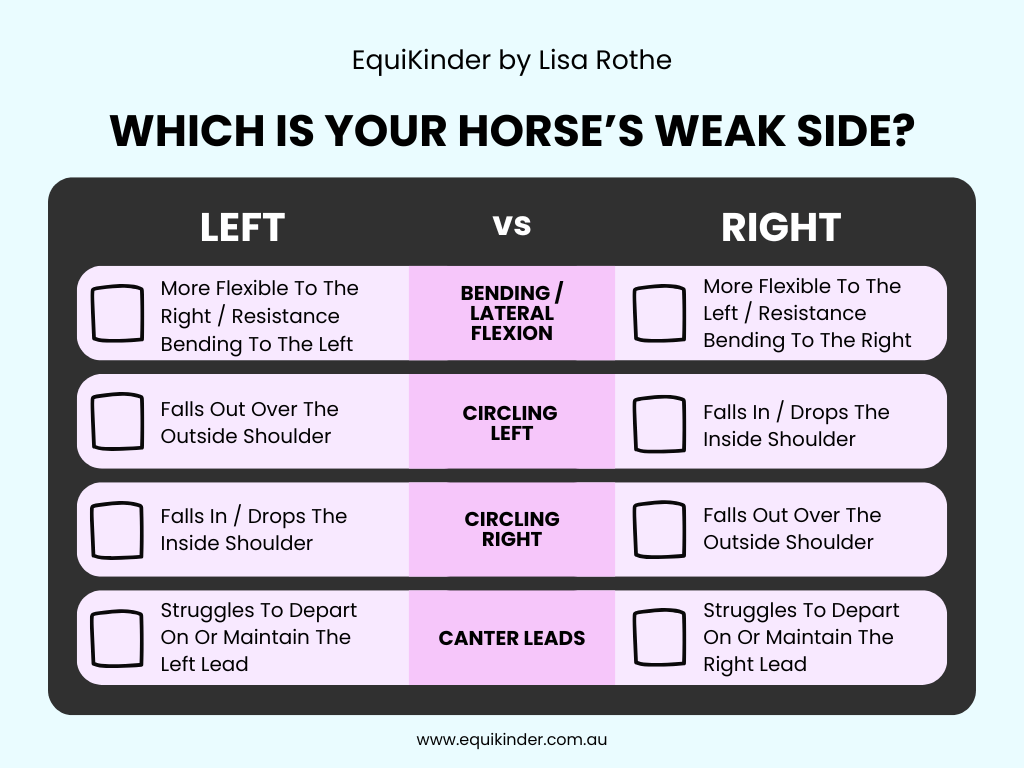
Click the link below to download:
Five Key Exercises to Balance Out Your OTTB
1. Shoulder-Fore/In Work
Why it helps: Many OTTBs drift through the outside shoulder because the hind inside doesn’t step under enough. Shoulder-fore/in work straightens the body, strengthens the weaker hind, and teaches balance between both diagonals.
How to do it: On the rein where your horse drifts, ride a shoulder-fore/in: bring the shoulders slightly inside the track while keeping the hindquarters straight. Reward small moments of alignment and gradually increase duration.
2. Spiral In & Out for the Weaker Hind
Why it helps: The hind leg on the weaker side is often underused, which makes canter departures and balance in that direction more difficult. Strengthening this leg helps even out power between both hind legs.
How to do it: On a 20m circle, gradually spiral smaller, then push the horse back out with your inside leg. This strengthens the weaker hind leg, improves engagement, and makes canter leads smoother.
3. In-Hand Flexions for Softer Contact
Why it helps: Many OTTBs brace against one rein and ignore the other due to how they were ridden in racing. Flexion work teaches them that both sides of the mouth matter equally and encourages softness instead of leaning.
How to do it: On the ground, ask for small lateral and vertical flexions. Reward the smallest give and avoid over-asking. Gradually, your horse will carry this softness into ridden work.
4. Transitions on a Circle
Why it helps: Circles often reveal crookedness. Horses collapse inward or drift outward depending on their stronger side (see assessment section above). Transitions on a circle keep the shoulders aligned and build strength in the weaker side.
How to do it: Ride walk–trot–walk or trot–canter–trot transitions on a 20m circle. Focus on keeping the shoulders steady: use your inside rein to lift the inside shoulder if the horse falls in, and your outside rein to set a clear boundary and prevent drifting out. Reward straightness through each transition.
5. Pole Work in Stretch
Why it helps: Many OTTBs have been conditioned to run in an inverted frame and will brace against the saddle. Pole work encourages them to swing through the back, stretch, and build a correct topline.
How to do it: Set trot poles and ride them on a long rein or soft contact. Praise forward, swinging steps and moments of genuine stretch. Over time, this helps them relax their topline and develop correct posture.
Training Principles to Keep in Mind
When retraining your OTTB, the how is just as important as the what. Here are some key principles:
- Don’t drill: Short, focused efforts build strength without souring the horse. Quality over quantity always wins.
- Favor the weaker side: Spend a little more time strengthening the weaker side, but still work both sides so you don’t create a new imbalance.
- Reward often: Praise and release for small tries. OTTBs thrive on clarity and quick feedback.
- Balance mental and physical: Remember these horses are learning to use their bodies in a completely new way. Mix easier work with harder exercises to keep confidence high.
- Build gradually: Straightness and symmetry develop over months, not weeks. Think of it as gym training: consistency matters more than intensity.
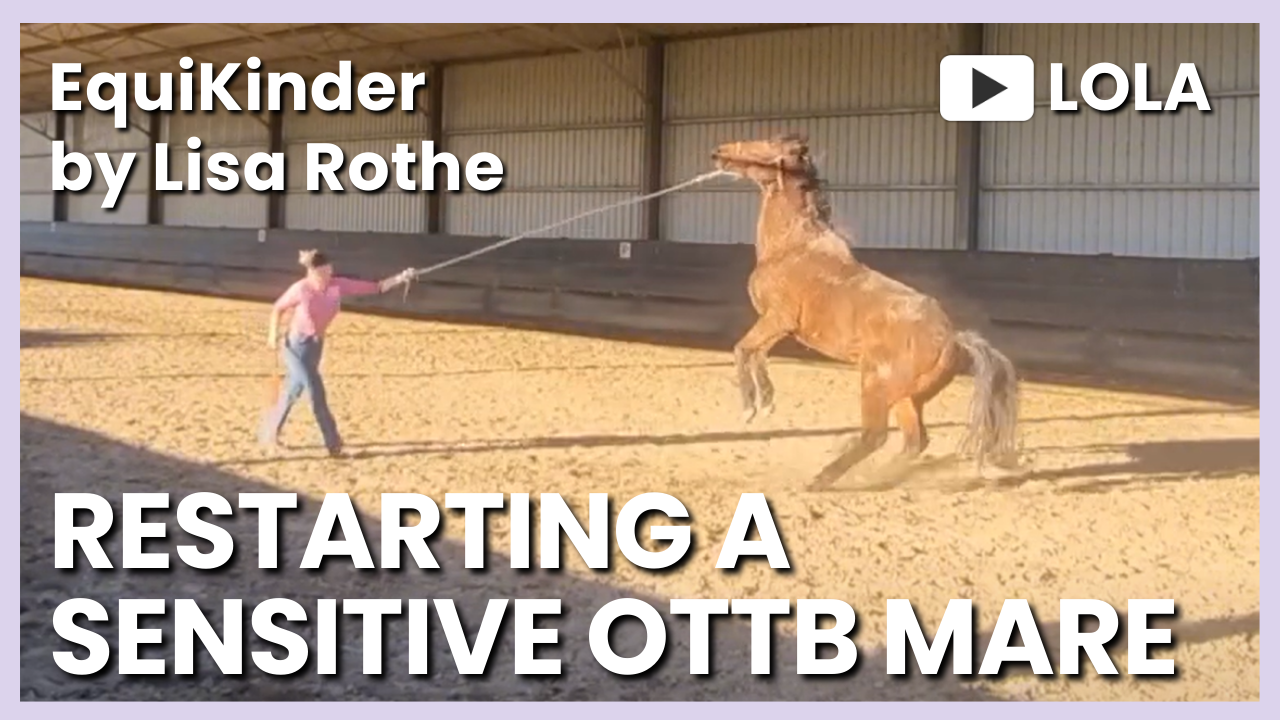
Want to see OTTB training in action?
If you’re interested in training off-the-track Thoroughbreds, check out my video series where I restart Lola, a reactive OTTB mare >Watch Now
The Value of OTTBs Beyond the Track
Off-the-track Thoroughbreds are remarkable horses. They come to us with a rich history (sometimes inspiring, sometimes challenging), and our role is to give them a meaningful life beyond racing. It’s important to set realistic expectations: these horses often carry both strengths and weaknesses from their time on the track. They can be sensitive, powerful, intelligent, and generous, but they also may bring physical asymmetries or mental anxieties that need time and patience to unwind.
Above all, the first step in retraining is not mechanics but trust. Before asking for balance, straightness, or collection, focus on making your horse feel safe and secure. Safety and confidence are the foundation for everything else. From there, the exercises and principles outlined here can gradually help your OTTB build a new body and a new mindset.
Each OTTB is an individual. Avoid labels, and avoid treating them as a stereotype. Some may breeze through retraining, others may need months of careful, compassionate handling. Always train the horse in front of you, with their history in mind. Reward effort, forgive mistakes, and celebrate progress.
And if behaviours ever escalate or feel unsafe, don’t hesitate to seek professional help. With the right support, these horses can transform into versatile partners and deeply rewarding companions. Love them for who they are! Because OTTBs are, at their core, beautiful horses who deserve a second chance.
Written by Lisa (with the help of AI)
EquiKinder by Lisa Rothe – Where Horsemanship Meets Personal Growth

Have Any Questions?
Join our monthly Q&As
Discover more from EquiKinder by Lisa Rothe
Subscribe to get the latest posts sent to your email.
