When it comes to teaching children and teens to ride, riding itself is just one piece of the puzzle. At EquiKinder, we believe that true horsemanship starts with understanding, connection, and feel, not just technique.
To help young riders develop into confident, capable equestrians, we follow a structured training scale. A step-by-step approach that builds both the rider’s seat and communication skills while fostering a strong partnership with the horse.
Audio Companion
Want to go deeper into how we use this scale in real lessons at EquiKinder?
Listen to my reflections and behind-the-scenes insights in this short audio episode:
Following a Structured Training System
The rider’s training scale by the German Equestrian Federation (FN) emphasizes that riders should progress systematically. They need to develop essential skills in the correct order. This ensures they not only become technically skilled but also develop a deep understanding of their horse.
At EquiKinder, we adapt this proven system to young riders, focusing on safety, confidence, and ethical horsemanship.
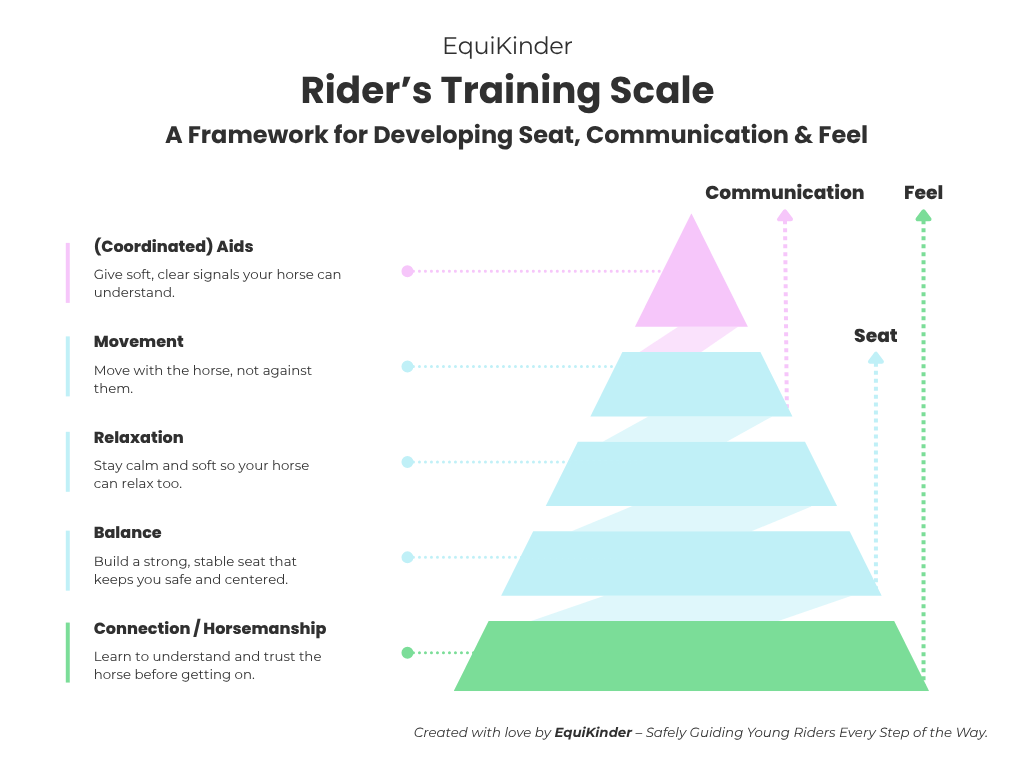
The Rider’s Training Scale
Foundation: Connection & Horsemanship
“The basis of all good riding is understanding the horse.”
Before learning riding techniques, children must first understand the horse’s nature, behavior, and body language. This phase includes:
- Learning how horses communicate and react to their environment
- Developing trust and respect between horse and rider
- Mastering basic groundwork and handling
This foundation ensures a horse-first approach that prioritizes the horse’s well-being.
Balance, Relaxation & Movement (Development of the Seat)
“A good seat is the key to effective riding.”
The training scale highlights balance and relaxation as essential before introducing aids. Riders at this stage learn to:
- Sit securely and independently, without relying on reins or stirrups
- Move in harmony with the horse, improving their coordination
- Maintain relaxation, reducing tension and resistance
A well-balanced rider can communicate more clearly and ride safely.
Aids & Coordinated Aids (Development of Communication)
“Riding is a dialogue between horse and rider.”
Once a rider has control over their own balance and movement, they can begin refining their communication through coordinated aids by:
- Understanding the correct use of seat, leg, and rein aids
- Learning how to apply aids gently and effectively
- Developing timing and coordination in transitions
Rather than relying on force or mechanical aids, we teach soft and natural communication.
Development of Feel (Mastery & Refinement)
“Feel cannot be taught, it must be developed.”
The final stage of this training approach is developing feel, where riders begin to:
- Sense their horse’s rhythm, energy, and responses naturally
- Make subtle adjustments without overthinking
- Ride harmoniously, creating a true partnership
At this level, riders understand that riding isn’t about control. It’s about connection!
Why This Approach Works for Young Riders
- It follows an internationally recognized system proven to create skilled, responsible riders.
- It ensures safer learning, focusing on seat development before technical skills.
- It develops well-rounded horse people, not just riders, fostering respect and empathy for horses.
Building the Future of Riding & Horsemanship
We follow the rider’s training scale. This ensures that young riders at EquiKinder receive an education that is structured, ethical, and effective. This approach not only creates better riders, it also creates better horse people. This lays the foundation for a lifetime of confident and compassionate horsemanship.

Written by Lisa I Founder of EquiKinder (with the help of AI) – Safely Guiding Young Riders Every Step of the Way.
Discover more from EquiKinder by Lisa Rothe
Subscribe to get the latest posts sent to your email.

One thought on “EquiKinder’s Training Scale: A Structured Approach to Riding”