
The Toolkit Approach
Each post in this series introduces a different tool for training horses. These tools aren’t steps in a method – they’re options you can pick and use depending on the horse and situation.
Many training programs are taught as a fixed method. The problem is, no single method works for every horse or every person.
That’s why I’m building The EquiKinder ToolKit instead. Each tool is a skill or concept you can learn, understand, and then choose to apply when it’s useful. The goal isn’t to follow steps – it’s to give you options and help you develop a feel for which tool fits the situation.
Every horseperson has heard of pressure and release. It sounds simple: apply pressure and take it away when the horse responds. But when you look closer, pressure and release isn’t just a training tool. It’s the foundation of how we communicate with horses, and it’s the most important tool you’ll want to understand if you’re building your own horsemanship toolbox.
What Is Pressure & Release?
Pressure and release is the basic language we share with horses.
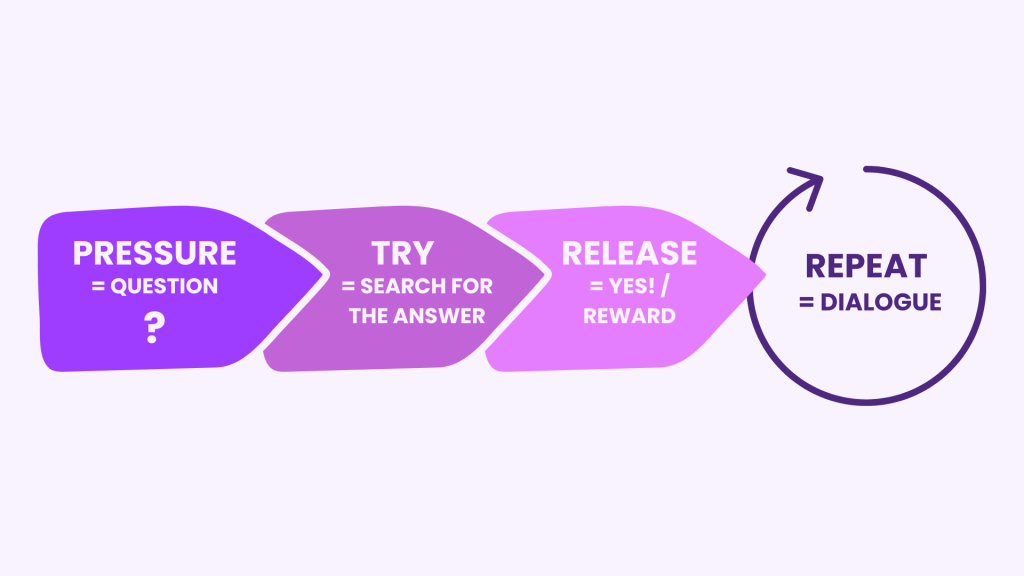
The easiest way to picture it is as a simple cycle of communication:
Pressure = Question (?)
Pressure is how we ask. It might be a feel on the lead rope, a leg aid, or even just our presence. Think of it as posing a question to the horse.
Try = Search for the Answer
The horse doesn’t automatically know what we want. They search for the answer: shifting weight, moving a foot, softening, experimenting with different responses.
Release = Yes! / Reward
The release tells the horse, “Yes, that’s it.” It’s the reward and the confirmation rolled into one. This is the moment the horse learns.
Repeat = Dialogue
The conversation continues. Each question, search, and release builds understanding. Over time, this back-and-forth creates a shared language between horse and human.
Rules of Good Communication
Pressure and release is a conversation. Like any conversation, it works best when the questions are fair and the answers are acknowledged. Many common mistakes come from asking in ways that confuse the horse or shut the dialogue down. Here’s how to turn those habits around into clear, supportive communication:
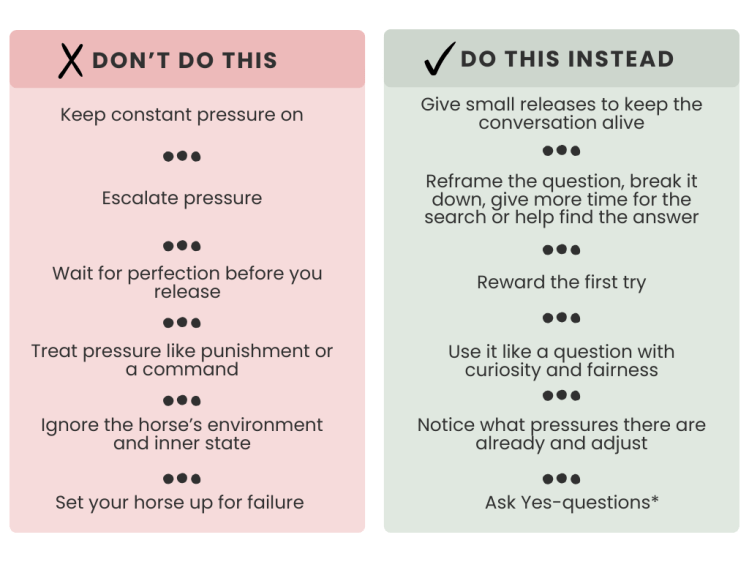
A Note on ‘Yes-Questions’
You’ll often hear the advice: “Only ask horses yes-questions.” What this really means is: set up questions your horse has a fair chance of answering successfully.
But there’s a balance to keep in mind:
- Too easy → The horse doesn’t need to search. They may get bored or stop engaging.
- Too hard → The horse can’t find the answer. They may become frustrated, resistant, or shut down.
- Just right → The horse has to search a little, but the answer is within reach. This creates curiosity, learning, and confidence.
A good ‘yes-question’ stretches the horse just enough to keep them searching without setting them up to fail.
Different Types of Pressure
Pressure isn’t always as simple as pulling on a rope or pressing with your leg. It shows up in different forms, and horses react or respond to all of them:
- Steady pressure – A consistent feel that is directly applied to the horse’s body. Example: Halter or leg pressure.
- Rhythmic pressure – A repeating motion or signal. Example: Tapping, waving, swinging a rope or flag.
- Energetic pressure – The feel of your posture, focus, and intent. Even without touching the horse, they can sense whether your “question” is gentle, curious, demanding, or unclear.
- Environmental pressure – External factors in the horse’s surroundings. Example: New places, loud noises, different footing, other horses, or unfamiliar objects.
- Internal pressure – The horse’s own inner state, such as tension, anticipation, adrenaline, pain, or anxiety. Internal pressure can be invisible to us but very real to the horse.
Recognising all these types of pressure helps us understand what the horse is experiencing and keeps our communication fair.
Timing and Release
The release is what teaches the horse. Pressure only sets up the question – the moment you let go tells the horse, “Yes, that’s it!”
Good timing means releasing the instant you see the try or the desired response. If the release is too late, the horse may not connect the dots. If you release at the wrong time, you might actually reward the wrong behaviour.
Release also isn’t all-or-nothing. Sometimes it’s a big obvious let-off, sometimes it’s just a softening of your hand, body, or energy. Horses notice both. The art is in knowing how much release to give for the effort in front of you – this is Feel!
Clear, consistent timing with the right kind of release builds confidence and helps your horse keep searching for the answer.
What if my horse doesn’t search or try?
Sometimes a horse doesn’t start searching for the answer right away. Here’s how to approach it:
- Reward the smallest try – A weight shift, a flick of the ears, a softening. Build from there.
- Hold and wait – A good guideline is up to about three seconds. That pause often feels long to us, but it gives the horse space to think. If you see searching, stay with them until they find it.
- Add clarity – If the horse doesn’t search at all, you can give them a little nudge, like a cluck or kiss, to reinforce: “This is a question – try something.”
- Reframe the question – If a horse explodes or panics, it’s usually because the question wasn’t clear or fair. Break it down, ask in a different way, or simplify the task.
- Help them connect – If they don’t understand one form of pressure, combine it with another they already know. This builds the bridge.
- Check for other pressures – If the horse’s attention is locked on the environment or they’re mentally somewhere else, get their focus back before you ask. Internal or external pressures may be competing with your question.
If your horse isn’t searching, it’s rarely stubbornness. It usually means the conversation broke down.
Reaction vs. Response
It’s important to notice the difference between a horse’s reaction and a response.
- A reaction is quick, tense, and comes from a place of instinct or self-preservation. The horse might do the thing you asked, but they skipped the searching and learning stage. Their body moved, but their mind wasn’t calm enough to take in the lesson.
- A response is thoughtful, softer, and shows the horse was mentally engaged in finding the answer. They went through the search → try → release cycle. That’s when true learning happens.
Why it matters?
If you release on a reaction, the horse may not actually connect the dots. They gave you movement, but they didn’t understand. Over time, this can create horses that look obedient but aren’t confident or curious.
Reaction
Movement is quick, jerky, and braced. The horse shoots straight into action without a weight shift or pause. Steps are choppy, rhythm breaks, head and neck stiff. Afterward, they either buzz on with tension or snap back into stillness and freeze.
The next repetition is harder: more anticipation, avoidance, or bigger brace; needs frequent resets.
Response
Movement begins with a small weight shift, then flows into a deliberate step. Rhythm stays steady, topline softer, footfalls quieter. Afterward, the horse melts – soft eye, easier breathing, able to stand or offer another step calmly.
The next repetition is easier: less pressure required, quicker soft try; learning carries over.
Rule of thumb: A reaction looks loud and unsettled. A response looks quiet, smooth, and leaves the horse more available for the next question.
Aim to release on the response, not the reaction. That’s how you build a horse that’s not only doing the task, but also learning and growing through it.
Turning a Reaction into a Response
If you see reaction signs, don’t escalate. Instead, “turn down” the pressure and give the horse time. Hold it calmly until they soften or slow down – that’s the moment a reaction can shift into a response. If they stay stuck, reset and start again. Sometimes that means breaking the question into smaller steps or going back a level to rebuild clarity.
A reaction isn’t bad behaviour – It’s feedback. A reaction always has a reason. It might be a missed try, a lack of understanding, outside pressure, or even pain.
Exercise: Practice the Conversation
This exercise isn’t about teaching the horse something new. It’s about building your own awareness of how pressure and release works as a language.
- Set up a simple ask
Choose something achievable for your horse, like asking them to take one step back on the lead rope. - Phrase it as a question
Out loud or in your head, say: “Can you take one step back?” (or whatever your ask is). - Watch the search
Notice what your horse tries. Do they shift weight? Flick an ear? Lift a foot? Narrate it to yourself: “He shifted his weight. He thought about stepping back.” - Pinpoint the release
The moment your horse makes an effort toward the answer, release the pressure. Say to yourself: “I released here because he tried.” - Repeat as dialogue
Ask again: “Can you take another step back?” Release when they try. Treat each step as its own question-and-answer cycle.
Trainer Tip
Do this as a short awareness practice, not a training session. The goal isn’t perfection. It’s training your awareness of the question → try → release cycle.

Building on the Basics
Once you’ve practiced pressure and release as a simple awareness exercise, you’ll start to notice it everywhere. The same cycle (question → search → release → repeat) applies whether you’re asking for one step back, a soft bend, or a lead change.
As you build, you can add layers to the question:
- More steps – from one try to several in a row.
- Different contexts – at the halt, in movement, under saddle.
- Refinement – lighter pressure, quicker try, smoother flow.
- Expression – eventually, pressure and release doesn’t just create obedience, it creates confidence and willingness.
Pressure and release is never “finished.” It grows with you and your horse. The better your timing and awareness become, the more you can shape not just what your horse does, but how it feels doing it.
Quick Guide
Pressure & Release
What is it?
A communication tool where pressure = question, release = reward/answer. It’s the basic language horses and humans share.
Why do we use it?
Because it’s clear, fair, and natural. Horses already understand pressure and release in the herd, in their environment, and in their own bodies. Done well, it creates not just obedience but trust, softness, and willingness.
How does it work?
The horse searches under pressure, finds the right answer, and learns from the release. Timing and clarity are everything.
When do we use it?
Everywhere. From basic handling to riding advanced movements. It’s the foundation of most training and our everyday language with horses.
When not to use it?
We always use it (consciously or subconsciously) whenever we interact with our horses. It’s our horses’ language, and we need to become fluent in it to communicate effectively with them.
Discover more from EquiKinder by Lisa Rothe
Subscribe to get the latest posts sent to your email.
