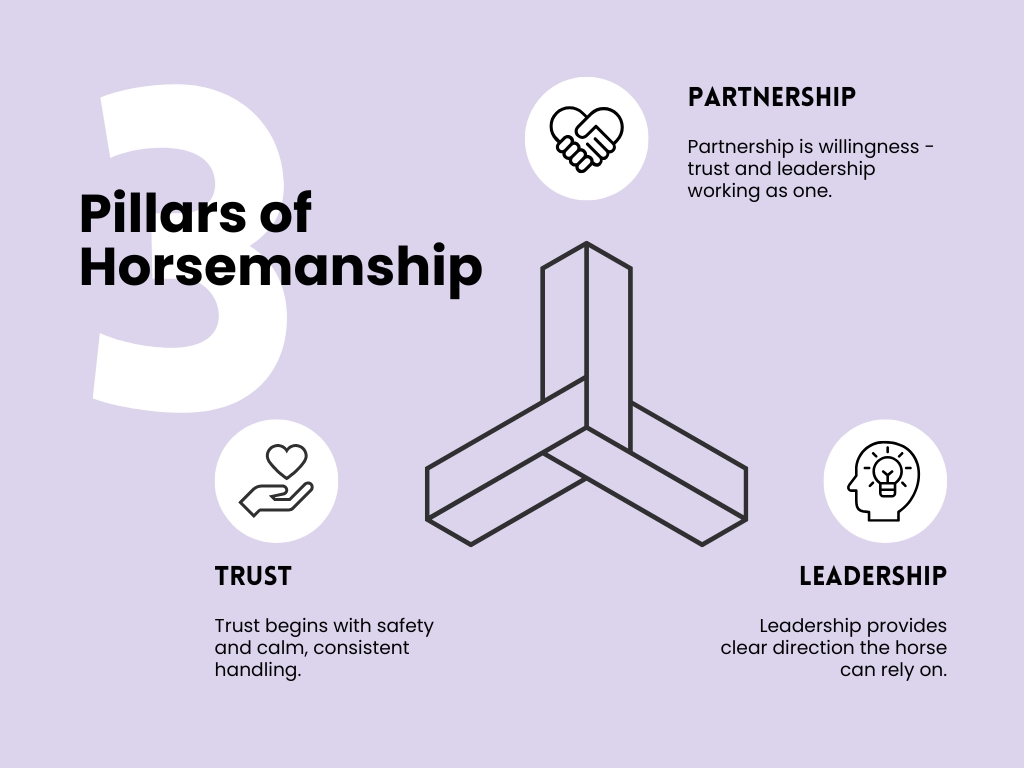
Every horse-and-human relationship is walking the same path: Trust → Leadership → Partnership.
It doesn’t matter if you’re colt starting, working through a behaviour issue, or simply enjoying your horse in the paddock – these three pillars are always at play.
This is not a program or a rigid method. Think of it as a compass. A way to orient yourself so you can make better decisions in the moment, with the horse in front of you.
Why the Order Matters
Trust comes first
Horses are prey animals. We are predators. When we first meet a horse, our direct eye contact, purposeful movements, and drive to “get something done” can feel predatory to them. If we skip trust and go straight into asking for tasks, the horse’s nervous system may read us as a threat. That’s when we see flight, fight, freeze, or fawn responses.
Trust communicates: “You are safe with me. I won’t harm you.” Without that, leadership feels like attack, not guidance.
Leadership follows
Once trust is present, horses expect someone to take responsibility. In a herd, if one horse raises its head in alarm, the others do too. If the lead horse lowers its head and relaxes, the herd follows suit. Leadership in a herd isn’t just about control. It’s about broadcasting safety.
When we step into leadership, we’re not just saying “move here or there” We’re also saying:
“If danger comes, I’ll take responsibility.”
“If something is unclear, I’ll guide you.”
“You can rely on me to keep you safe.”
Partnership is the refinement
Partnership happens when trust and leadership meet. It’s the dance, the flow, the place where aids become invisible, and the horse offers himself willingly. The question of “who leads and who follows” fades into harmony.
When One Pillar Stands Alone
Leadership without Trust
- Looks like control and compliance.
- The horse obeys but carries tension or dullness.
- When pressure rises, obedience unravels because safety was never established.
Trust without Leadership
- Looks like safety without direction.
- The horse is calm but pushy, unclear, or lost under guidance.
- Connection feels nice, but it doesn’t hold up under challenge.
Both Are Needed for Partnership
- Trust without leadership is friendship without an anchor.
- Leadership without trust is control with no heart.
- Partnership is the fusion of both – safety and clarity, kindness and direction.
What Horses Really Need to Trust Us
Trust is not just about “being nice” or spending hours together. Horses learn to trust us when:
- They feel heard: their signals and thresholds are noticed.
- They aren’t pushed into panic: pressure is released before overwhelm.
- They aren’t punished for trying: mistakes are treated as communication, not defiance.
- We show up consistent and calm: our nervous system steadies theirs.
Trust is the horse’s way of saying:
“With you, I feel safe.”
Good Leadership vs. Bad Leadership
A horse can tell the difference instantly. They may comply under bad leadership, but they will never willingly follow. Good leadership, by contrast, feels like an anchor: “I can relax, because you’ve got me.”
Good Leadership
- Rooted in trust and fairness.
- Clear, consistent, and predictable.
- Intention is calm and purposeful.
- Takes responsibility for safety, not just obedience.
- Uses pressure as guidance, not punishment.
Bad Leadership
- Rooted in fear, ego, or frustration.
- Inconsistent or confusing.
- Intention is harsh or chaotic.
- Demands obedience without offering safety.
- Uses pressure as force, leaving the horse guarded.
Not a Checklist
These pillars aren’t boxes you tick once and forget about.
- Trust must be re-earned every day.
- Leadership must be proven in each interaction.
- Partnership must be tended like a fire, or it fades.
Think of it like tending a garden: you don’t water a seed once and expect it to thrive. You return daily to nurture what’s been planted.
The Pillars and Their Tools
Pillar One: Trust (Safety & Willingness)
- Observation – watch before you act.
- Predictability / Patterns – consistency is safety.
- Approach–Retreat – pressure that relieves before panic.
- Calm Presence – your nervous system sets the tone.
Success marker: The horse stays curious and open around you.
Pillar Two: Leadership (Direction & Clarity)
- Boundaries as Clarity – defining your personal space.
- Pressure & Release – steady, rhythmic, or energetic.
- Directional Aids – draw vs. drive, leading with intention.
- Energy Intention – focus, posture, and breath as signals.
Success marker: The horse respects your space, follows light cues, and finds comfort in your guidance.
Pillar Three: Partnership (Harmony & Refinement)
- Liberty – joy and choice, no strings attached.
- Self-Carriage – the horse maintains rhythm and posture without your help.
- Lateral Work as Conversation – yields become dialogue, not drills.
- The Dance in Riding – aids so soft they’re almost invisible.
Success marker: The horse offers willingness; movement feels fluid, like dancing with a partner who knows the steps.
Final Thought
We often swing between extremes:
- Old-school “show them who’s boss” obedience.
- New-school “be kind at all costs” permissiveness.
Horses need both.
They need to feel safe (trust),
and they need someone to rely on (leadership).
Only then do they offer true willingness (partnership).
So don’t be afraid of the word leadership. When it’s rooted in trust, leadership isn’t domination. It’s responsibility. It’s you saying: “You’re safe with me. I’ll guide us both.”
That’s when partnership begins.
Discover more from EquiKinder by Lisa Rothe
Subscribe to get the latest posts sent to your email.
