

If you’ve spent any time in the horse world (online forums, clinics, or paddock conversations), you’ve probably heard the debate: “Do you train your horse with pressure or food rewards?” It’s a catchy shorthand, and it makes for strong opinions. Positive reinforcement (R⁺) with food rewards has been gaining ground, while traditional negative reinforcement (R⁻), pressure and release, has been the backbone of horsemanship for centuries. The conversation often sounds like a competition: which method is kinder, more effective, or more ethical?
But here’s the problem: the labels don’t capture reality. Horses aren’t debating quadrants; they’re experiencing what we do moment by moment. And most trainers (whether they admit it or not) already use a mix of both. Even the most committed R⁺ trainer uses pressure at times (a lead rope, a hand on the chest), and even the most traditional R⁻ trainer often rewards with scratches, a pause, or a kind word.
So instead of asking, “Which camp are you in?” maybe the better question is: “What does my horse need in this moment?” Because when we zoom out from the binary, we start to see that R⁺ and R⁻ aren’t enemies – they’re just tools. Tools that can either help or hinder, depending on how, when, and why we use them.
The Four Tools Every Trainer Uses (Whether They Admit It or Not)
R+ Positive Reinforcement
Adding something the horse finds rewarding to increase the likelihood of a behaviour happening again.
Example: The horse touches a target → you give a treat.
P+ Positive Punishment
Adding something the horse finds uncomfortable to reduce the likelihood of a behaviour happening again.
Example: Horse bites → you sharply raise your hand to interrupt.
R- Negative Reinforcement
Removing something the horse finds uncomfortable or motivating when they offer the correct behaviour, to increase that behaviour in the future.
Example: You apply leg pressure → horse moves forward → you remove the pressure.
P- Negative Punishment
Removing something the horse wants to reduce the likelihood of a behaviour.
Example: Horse pushes into your space while leading → you stop walking and remove forward movement (something they wanted).
Common Misconceptions
- The “positive” and “negative” labels describe adding or removing, not moral values of “good” and “bad”.
- None of these are automatically “ethical” or “unethical”. It depends entirely on timing, the trainer’s intention, and how the horse perceives the experience. (More on understanding a horse’s perception later in this blog.)
- All four can appear in a single session, even with highly ethical trainers.
Predator vs Prey: Why These Tools Exist in the First Place

The roots of positive/negative reinforcement come from how different species naturally learn. Predators thrive on seeking and reward (hunting, playing, problem-solving), making reward-based methods feel intuitive. Prey animals, like horses, survive by responding to pressure and finding safety in its release.
This means that R+ often feels “natural” to predators (play → reward) and R– often feels “natural” to prey (pressure → release). Horses instinctively scan for ways to remove pressure, while humans may gravitate toward adding rewards. Neither is “better”, but our default instincts can shape training choices, for better or worse.
While rewards can be effective for prey animals, they only work if the horse feels safe enough to engage in seeking behaviour. If fear or tension is present, the prey brain prioritizes survival over curiosity, making pressure-and-release approaches more accessible in that moment. On the other hand, horses’ prey brains are wired for self-protection, and too much predator-style pursuit, or poorly timed pressure, can trigger fear or shutdown. Softening our approach by blending clarity, timing, and empathy, helps bridge the predator–prey gap and ensures the tool we choose matches both the horse’s emotional state and how they learn best.
Trainer Reflection Prompts
- Is my horse in a seeking state (able to eat/engage) or a scanning state (tight, vigilant)?
- Can I fade the cue the instant I see the first try, so the release is obvious?
- Once regulation returns, where could a well-timed mark & reward help the horse want the next try?
Why This Debate Misses The Bigger Picture
The problem with most conversations about R⁺ versus R⁻ is that they often reduce to black-and-white positions that leave no room for context. A horse’s behaviour doesn’t live in a vacuum: it’s shaped by their history, by the skill of the handler, and by what’s happening in the moment. Timing, intention, and perception all play a part, and those don’t fit neatly into quadrant labels.
When the conversation becomes about who is “right” and who is “wrong,” it’s easy to lose sight of what actually matters: what does the horse in front of you need right now? This is where the so-called “method wars” do the most damage. Instead of encouraging curiosity and learning, they create judgement and division. “R⁺ trainers” are accused of spoiling horses. “R⁻ trainers” are painted as harsh or old-fashioned. Both stereotypes miss the truth that in real life, most trainers use elements of both, whether they acknowledge it or not.
And perhaps most importantly, the quadrant alone doesn’t tell you if your horse feels safe or seen. You can be technically using R⁺, but still leave the horse anxious if you miss the moment. You can be technically using R⁻, but still feel unfair if the pressure escalates past what the horse can handle. The horse isn’t reading a science textbook; they’re reading your energy, your timing, and the way the interaction makes them feel.
The debate falls short when it argues theory in isolation, instead of recognising that what really matters is how the method lands in the horse’s nervous system.
The Missing Pieces: Energy, Intention, and Emotional Safety

One of the biggest blind spots in this debate is that it rarely accounts for the horse’s nervous system. Before a horse can learn, they must feel safe enough to process and respond. You can be applying a textbook-perfect quadrant, but if the horse is in flight mode, the lesson won’t land.
This is where energy and intention matter more than theory. Horses don’t just respond to cues; they respond to how those cues are delivered. A raised hand can be read as either an invitation or a threat. A release can be a sigh of relief or a dismissal. The difference comes down to the emotional state of both horse and handler, and the intention behind the aid.
Take negative reinforcement as an example. Applied with lightness, R⁻ can guide a horse with clarity and create confidence: pressure comes, the horse tries, and the pressure melts away. Applied with insistence or escalation, the same principle can become overwhelming, pushing the horse through fear and leaving them less trusting the next time.
The same is true for positive reinforcement. A well-timed reward can brighten the horse’s curiosity. But if offered when the horse is still tense or braced, food can actually add agitation, creating frustration instead of confidence.
The quadrant tells you what’s happening mechanically. The horse’s body and mind tell you what’s happening emotionally. And it’s the emotional layer (safety, softness, and feel) that makes the difference between training that sticks and training that erodes trust.
The Devil’s Advocate: Bursting The Bubble

We often become comfortable with the method we use most, but that comfort can make us blind to its limitations. The reality is that the horse’s experience doesn’t always match our perception. Playing devil’s advocate with ourselves means asking tough questions in the moment: Is my horse feeling safe? Are they in a state where learning is possible? What might this look like from their point of view? Our own intention is only half the story – the horse’s perception is the other half. Let’s burst the bubble …
When R⁺ blurs into P⁻
Positive reinforcement is often framed as the kinder option, but it isn’t immune to pressure. If the timing is off or the reward is withheld too long, what the trainer sees as R⁺ can feel like P⁻ to the horse – a removal of something they were expecting. That sense of loss can create frustration and stress instead of curiosity. In other words, even “adding a reward” can turn into a kind of punishment if the horse perceives it that way.
When R⁻ blurs into P⁺
Negative reinforcement is praised for clarity and subtlety when done well, but the line between guidance and punishment is thinner than we like to admit. If pressure is escalated too strongly, too quickly, or held for too long, what started as R⁻ becomes P⁺ – adding an aversive that discourages rather than teaches. In that moment, the horse isn’t learning a pathway to safety; they’re experiencing pressure as punishment.
Recognising how easily quadrants blur reminds us that the horse’s perception (not our chosen label) is what ultimately defines the interaction. In other words, the horse is the only one who gets to decide whether a moment felt rewarding, punishing, safe, or stressful.
The Only Opinion That Counts: Your Horse’s
This is where the “good method” myth falls apart. A quadrant can look perfect on paper, but if the horse is too anxious to seek, R⁺ won’t work. If the pressure escalates past the horse’s tolerance, R⁻ won’t work. What looks “ethical” or “gentle” to us may still land as stressful to the horse.
Perception is where theory meets reality. By staying present to what the horse is telling us in each moment, we avoid hiding behind our favourite method and we put the horse’s experience back where it belongs: at the centre of training.
Instead of asking “Which quadrant is right?” the more useful question is:
How is my horse experiencing this moment?
We can’t read their minds, but we can make educated guesses based on their body language. That’s why learning to read subtle signs is so crucial. Relaxed blinking, a soft jaw, a lowered neck, an exhale – these are signs a horse is processing and regulating. Tension in the poll, pinned ears, a tight lower lip, or fixed eyes tell us the horse isn’t comfortable, even if we thought we were being “kind.”
Signs your horse is relaxed and learning
- Soft blinking or eyes gently closing for a moment
- Lowered neck and relaxed topline
- Loose lips or soft jaw
- Exhaling or sighing
- Chewing/licking after a release (paired with other relaxed signals)
- Curious, exploratory movements (sniffing, reaching out)
Signs your horse is tense or shutting down
- Fixed, wide, or glassy eyes
- Tight muzzle or grinding teeth
- High head carriage, rigid neck
- Rapid or anxious chewing without softness
- Holding breath or shallow, quick breathing
- Lack of responsiveness, “freeze” behaviour, or explosive overreactions
Why Both Methods Deserve A Place In Your Training
After picking apart the blind spots of both approaches, it’s worth remembering why they’ve both stood the test of time: each has areas where it naturally excels. The art of horsemanship isn’t choosing a camp; it’s knowing which tool serves the horse in front of you best.
The Confidence Builder
Positive reinforcement can be a game-changer in building curiosity, confidence, and play. Shut-down or young horses often benefit when you mark and reward even small tries toward engagement. The food or scratch doesn’t just reinforce behaviour; it flips the emotional tone of the moment, making exploration feel safe and rewarding. R⁺ is also powerful for teaching new, non-instinctive behaviours (like targeting, tricks, or standing at the mounting block) because it taps into the horse’s seeking system and makes repetition enjoyable.
The Clarity Maker
Negative reinforcement, when applied with fairness and lightness, creates clarity and subtle communication. It’s especially useful for teaching clear movement cues: yielding to the leg, moving off pressure, finding straightness, or refining balance under saddle. R⁻ is also invaluable in urgent scenarios: when you need a horse to respond quickly to pressure for safety’s sake, such as moving away from danger or yielding in a tight space.
R⁻ Equals
- Creating clarity
- Refining Movement
- Improving Balance
- (Emergency) Responsiveness
R⁺ Equals
- Building Curiosity
- Confidence
- Playfulness
- Teaching novel behaviours
The Sweet Spot
The real power comes in blending the two. R⁻ can provide the clarity of “what to do,” while R⁺ can add motivation, enjoyment, and confidence to keep the horse trying. Obstacles are a perfect example: R⁻ can guide the horse to approach, and R⁺ can reward each moment of curiosity or bravery. Together, they create a balance of safety, clarity, and engagement.
At the end of the day, loyalty to a quadrant is less important than loyalty to the horse’s needs. The horse doesn’t care what label you use; they care whether they feel safe, understood, and encouraged to try.
Forget Methods: Here’s How to Actually Pick the Right Tool
If there’s one thing the quadrant debate often misses, it’s that there isn’t a single “right” method.
There’s only the right method for this horse, in this moment, for this goal.
That means decision-making has to be practical, responsive, and flexible rather than ideological.
A simplified decision-making process
What’s your horse’s emotional state?
If your horse feels unsafe, no reward will land as a reward. In that case, clarity and calm guidance (often through R⁻) is the first step. Only once the horse is regulated and curious can R⁺ work as intended.What’s the learning goal?
If you need precise movement, balance, or quick responsiveness, R⁻ tends to be clearer. If you’re looking to build confidence, curiosity, or playful engagement, R⁺ can open doors.Which tool builds trust instead of eroding it?
The “right” method is the one that doesn’t push the horse over threshold, doesn’t create resentment, and leaves the partnership stronger at the end of the session. Sometimes that means swapping between R⁻ and R⁺, depending on how the horse is coping in real time.
Switching fluidly within a session
Good training is rarely “pure.” You might begin with gentle R⁻ to create clarity, then layer in R⁺ to reward bravery, then pause to let the horse process. Or you might start with R⁺ to build curiosity, then use a moment of R⁻ to create the physical response you need, before returning to rewards and rest. Horses don’t think in quadrants; they think in experiences. Blending fluidly, without attachment to labels, is what keeps training humane, adaptable, and effective.
At the end of the day, the quadrant matters less than the answer to this question:
Did the horse walk away feeling safer, clearer, and more willing to try again tomorrow?
My Compass: Congruence Over Quadrants

After all this discussion about quadrants, methods, and blending, I want to be clear: I don’t see myself as an “R⁺ trainer” or an “R⁻ trainer.” My compass isn’t about loyalty to a label. It’s about congruence.
For me, congruence means that what I ask, what I feel, and what I reward all line up. It means I’m consistent in my signals, honest about my intentions, and tuned into the horse in front of me rather than the method in my head.
That doesn’t mean I never make mistakes. I’ve misjudged timing, applied too much pressure, withheld a reward for too long. But the guiding principle I come back to is simple:
Did the interaction leave the horse more regulated, more willing, and more connected than before?
If the answer is yes, then the tool served its purpose. If the answer is no, then it’s time to reflect and adjust.
And here’s something I think we need to remind ourselves of more often: We’re allowed to experiment! We’re allowed to test the waters in different quadrants, to try something new, and to reflect on how the horse experienced it. We won’t always get the timing perfect, or pick the textbook “right” method in every moment. But as long as our intention is clear, curious, and fair, horses don’t hold it against us. They don’t need us to be flawless; they need us to be present, adaptable, and willing to listen.
That’s why my compass is less about quadrants and more about congruence, curiosity, and flexibility. Training isn’t a fixed formula. It’s an ongoing dialogue. And the more open we are to evolving, to learning, and yes, to having fun in the process, the more our horses can trust us to guide them with honesty and care.
If you’d like to dive deeper into how I put this into practice, I’ve written another post that explains my horsemanship philosophy and approach to training horses in more detail.
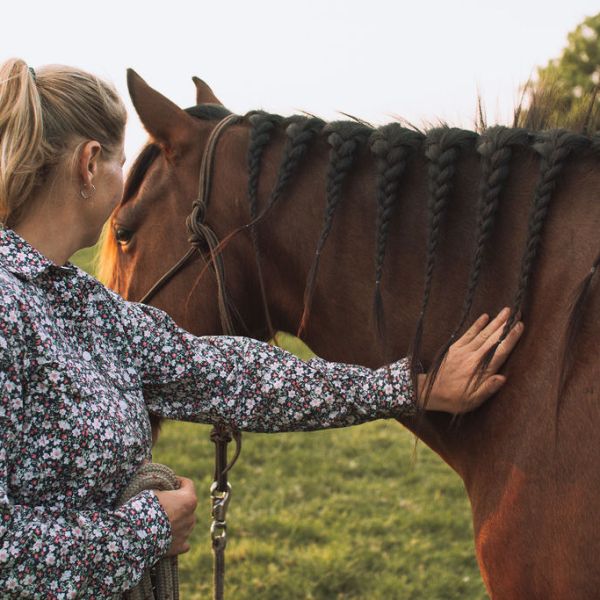
Anchored Attunement: Finding Balance in a Divided Horsemanship World
Anchored Attunement is the heart of my horsemanship philosophy – a balance of calm leadership and emotional presence. In this post, I explore how I found my way through the noise of competing styles and built a grounded, flexible approach based on congruence, curiosity, and connection.
Let’s Keep the Conversation Alive (For the Horse, Not Our Egos)
The R⁺ vs. R⁻ debate doesn’t need winners or losers. What it needs is curiosity and conversation. Horses don’t benefit when we dig our heels in and defend a camp. They benefit when we share openly, reflect honestly, and stay willing to adapt.
I’d love to hear your stories. Maybe you tried something you thought was “right” but it didn’t land the way you expected. Maybe you were surprised by an approach you’d dismissed before, but that worked beautifully for your horse. Or maybe you’ve seen how switching tools mid-session gave your horse the clarity or confidence they needed.
And yes, I also welcome critique. If you disagree with something I’ve written here, or if you see blind spots in my own approach, I want to know. The point isn’t to prove one of us right. The point is to create a conversation that makes us all better horse people, because at the end of the day, the only ones who truly win are the horses.
So let’s move this forward – not as a debate, but as a dialogue. Share your thoughts, your experiences, your questions below. Let’s learn together!
Written by Lisa (with the help of AI)
EquiKinder by Lisa Rothe – Where Horsemanship Meets Personal Growth
Have Any Questions?
Join our monthly Q&As
Discover more from EquiKinder by Lisa Rothe
Subscribe to get the latest posts sent to your email.
